
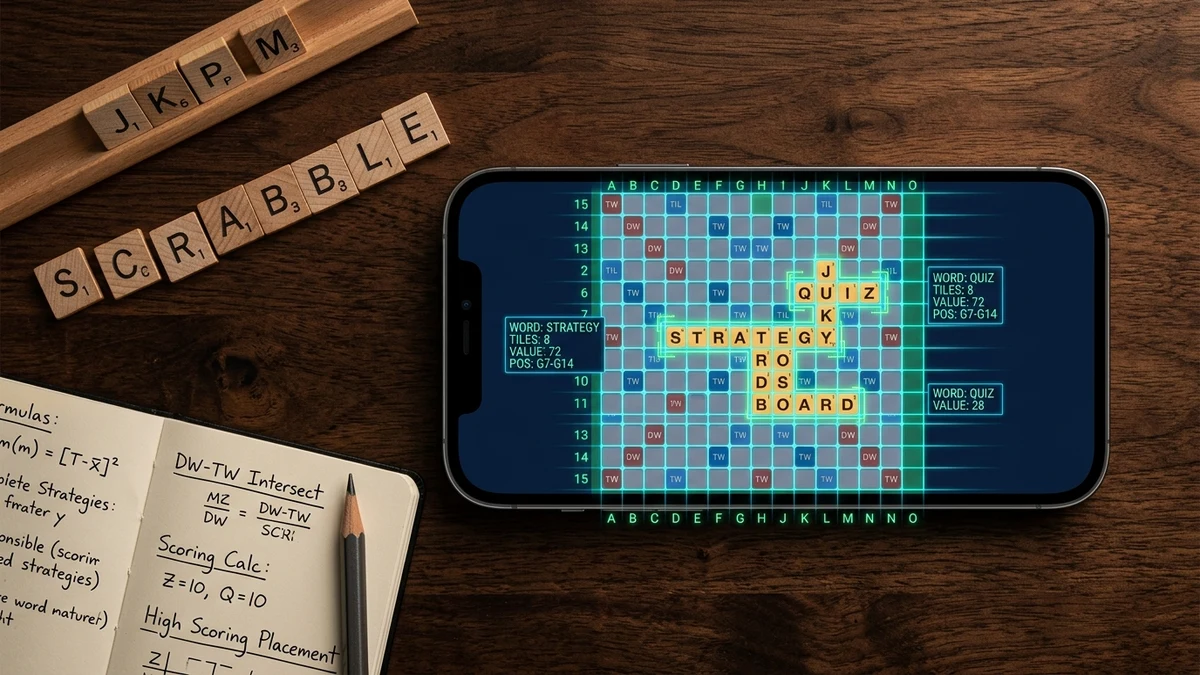
How Optical Character Recognition Models Game Boards
Competitive word game players frequently encounter complex endgame boards where manual letter entry consumes valuable turn countdown time. The board screenshot solver applies multi-stage optical analysis: first establishing perspective homography rectification to square tilted or off-angle phone screenshots, then executing Hough transform line segment detection to identify the four outer perimeter bounds of the 15×15 grid matrix.
Once individual cell contours are isolated, the recognition pipeline applies Otsu adaptive binarization and morphological kernel filtering to differentiate empty bonus squares from occupied wooden or ivory tiles. Letter glyphs are matched against normalized character feature vectors, while subscript point badges confirm tile authenticity and disambiguate similar letter forms such as capital I and the numeral 1.
Client-side WebAssembly routines extract the bottom tray coordinates, reading the 7-tile player rack into an editable buffer. If an unprinted blank tile is detected, the engine flags it as a 0-point wildcard, systematically testing all 26 alphabetical permutations against board anchors instantly.
Words With Friends 2 vs. Scrabble Board Layout Differences
Words With Friends 2 Grid Topology
Features a 15×15 grid with Triple Word (TW) squares positioned along edge coordinates rather than standard corners. Tile valuations reflect Zynga's custom weighting: J carries 8 points, C and M carry 4 points, and a 7-tile bingo awards a 35-point bonus. Corner proximity creates defensive cluster opportunities where parallel 2-letter hook words compound across multiple multiplier tiles.
Scrabble GO & Tournament Scrabble
Employs traditional NASPA NWL20 and Collins CSW21 geometry: 8 corner Triple Word scores and symmetrical diagonal Double Word paths leading to the center star. Using all 7 tiles yields a substantial 50-point bonus, prioritizing bingo openings. Tile distributions assign 10 points to J and Q, rewarding aggressive early offensive tile dumps on isolated Triple Letter coordinates.
Capturing Phone Screenshots for Maximum OCR Accuracy
To ensure 100% optical character recognition precision, capture clean screenshots when the board is completely static. Dismiss chat notification bubbles, animated coin banners, and in-game magnifying lenses before triggering your mobile device screen capture shortcut on iOS or Android.
Verify that your device screen display settings are set to standard or true tone without aggressive blue-light filtering or high-contrast night tinting. Extreme color grading shifts bonus square spectral histograms, occasionally causing Triple Letter green squares to register as neutral gray cells.
Ensure the screenshot captures the entire vertical canvas including the active rack well at the bottom. Do not crop the status bar or navigation header manually, as the recognition engine relies on standard device aspect ratios (19.5:9 and 20:9) to calculate the vertical offset of the game grid with sub-pixel precision.
Algorithmic Trie Evaluation and Anchor Multiplier Mechanics
Raw anagram generators fail on live board positions because they evaluate letter racks in isolation, ignoring existing board letters. Our computer vision solver feeds extracted board matrices into a directional prefix tree (trie) that traverses all legal anchor squares simultaneously.
Each candidate placement is evaluated across two perpendicular axes: the primary word vector and any secondary parallel hook words formed with adjacent tiles. When placing high-scoring consonants like Z (10 pts) or X (8 pts) across an intersecting Double Letter (DL) and Triple Word (TW) square, the letter multiplier applies to both words before the word multiplier triples the cumulative score, unlocking 60+ point plays from ordinary 4-letter words.
Defensive Tile Tracking and Endgame Probability Models
Mastering tournament play requires tracking which letters remain in the virtual tile bag. When your board screenshot is analyzed, the recognition engine compares visible board tiles and your active 7-tile rack against the canonical 100-tile Scrabble or 104-tile Words With Friends distribution.
By subtracting played tiles, the solver deduces your opponent's prospective rack composition during crucial endgame turns. If high-value power tiles like Q or Z remain unplayed and no Triple Word lanes are accessible, strategic positioning dictates locking down open vowel hooks to force opponent pass turns or rack deadlock penalties as the tile pool depletes. Evaluating tile bag telemetry transforms defensive play into an empirical mathematical advantage, converting difficult letter draws into calculated tournament victories.
Contextual Internal Exploration & Playbooks
For specific tile dilemmas and advanced tactical reference, consult our specialized directories:
WWF2 15×15 Board Simulator
Interactive manual grid model for testing complex crossing plays.
Official 2-Letter Hook Matrix
Master all 107 tournament connectors for parallel scoring.
Words With J Directory
Maximize 8-point and 10-point J tiles on multiplier squares.
Words With X List
Explore high-scoring 2-letter to 7-letter plays featuring letter X.
Frequently Asked Questions About Board Screenshot Solving
Can I upload screenshots from both iPhone and Android devices?
Yes. The board screenshot solver accepts standard PNG, JPG, and WebP screenshots from iOS and Android devices running Words With Friends 2, Scrabble GO, or NYT Crossplay.
Does the solver detect blank wildcard tiles on the board and rack?
Yes. Blank tiles without point subscripts are automatically mapped as wildcards (represented by ?), enabling the solver to test all 26 alphabetical permutations against board anchors.
How does the tool distinguish Words With Friends 2 from Scrabble rules?
The solver provides dedicated board topology engines. Words With Friends 2 mode evaluates Zynga's unique bonus coordinates and letter values (such as J=8, C=4), while Scrabble mode applies Hasbro/Mattel rules (J=10, C=3).
Are my uploaded game screenshots stored on external servers?
No. All optical recognition and board tile calculations execute entirely inside your local browser runtime via HTML5 Canvas and client-side scripts, guaranteeing complete player privacy.
Can I manually correct a tile if my screenshot had glare or notification banners?
Yes. The extracted player rack provides editable text slots. You can tap any slot to overwrite a misread letter or manually input missing tiles before recalculating moves.