
Words Without Vowels for Scrabble & Words With Friends
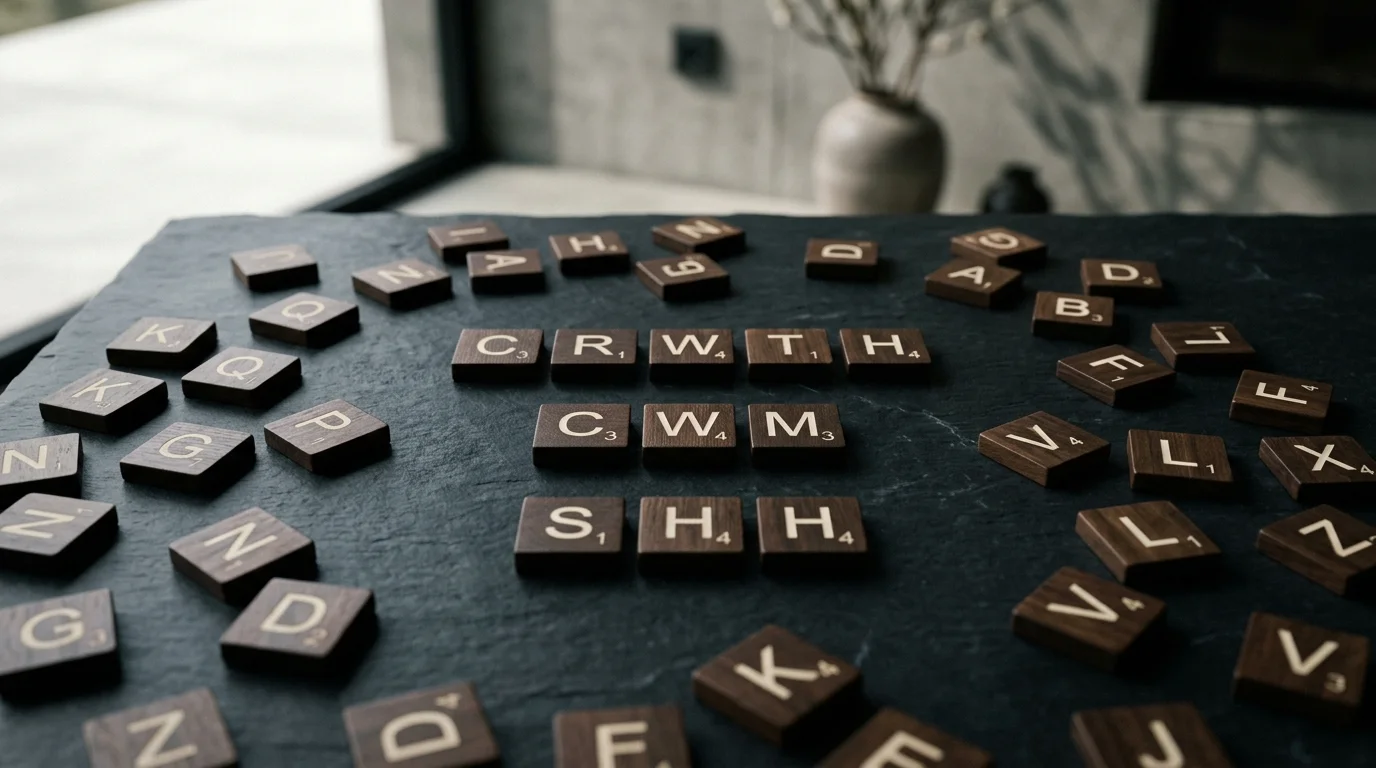
Words without vowels are critical defensive weapons when your rack contains seven consonants. Legal plays include strict zero-vowel terms CRWTH, CWM, SHH, and TSK, alongside vocalic-Y power plays BY, MY, LYNX, and the 25-point masterwork SYZYGY.
| Word | Type | Scrabble | WWF2 | Lexicon | Definition & Usage |
|---|---|---|---|---|---|
| Zero Vowels | 5 pts | 6 pts | NWL20+CSW21 | Interjection used to indicate that the speaker feels cold. | |
| Zero Vowels | 6 pts | 7 pts | NWL20+CSW21 | Extended spelling of brr expressing intense physical shivering. | |
| Zero Vowels | 14 pts | 14 pts | NWL20+CSW21 | An ancient Celtic bowed stringed musical instrument with a flat body. | |
| Zero Vowels | 15 pts | 15 pts | NWL20+CSW21 | Plural form of crwth; ancient Welsh musical instruments. | |
| Zero Vowels | 10 pts | 11 pts | NWL20+CSW21 | A steep-sided hollow or cirque on a mountainside (Welsh loanword). | |
| Zero Vowels | 11 pts | 12 pts | NWL20+CSW21 | Plural form of cwm; steep mountain hollows. | |
| Zero Vowels | 7 pts | 8 pts | NWL20+CSW21 | Interjection used to express thoughtful consideration or doubt. | |
| Zero Vowels | 8 pts | 9 pts | NWL20+CSW21 | Extended variant of hm expressing contemplation or skepticism. | |
| Zero Vowels | 6 pts | 6 pts | NWL20+CSW21 | Interjection expressing contented enjoyment or agreement. | |
| Zero Vowels | 6 pts | 6 pts | NWL20+CSW21 | Pertaining to an indefinitely large ordinal number (as in to the nth degree). | |
| Zero Vowels | 8 pts | 9 pts | NWL20+CSW21 | Interjection expressing mild annoyance, dismissal, or contempt. | |
| Zero Vowels | 6 pts | 7 pts | NWL20+CSW21 | Sibilant sound used to attract someone attention discreetly. | |
| Zero Vowels | 9 pts | 9 pts | NWL20+CSW21 | Urgent injunction to be quiet or maintain silence. | |
| Zero Vowels | 7 pts | 8 pts | NWL20+CSW21 | An exclamation of scolding disapproval or sorrow. | |
| Zero Vowels | 14 pts | 16 pts | NWL20+CSW21 | Doubled form of tsk expressing emphatic reproof. | |
| Zero Vowels | 30 pts | 30 pts | CSW21-Only | Sound symbolizing snoring, sleep, or deep slumber (CSW tournament play). | |
| Vowel Y | 7 pts | 7 pts | NWL20+CSW21 | Preposition identifying the agent or adjacent proximity. | |
| Vowel Y | 7 pts | 7 pts | NWL20+CSW21 | Possessive determiner indicating belonging to the speaker. | |
| Vowel Y | 8 pts | 9 pts | NWL20+CSW21 | Shed tears typically as an expression of sorrow or distress. | |
| Vowel Y | 7 pts | 7 pts | NWL20+CSW21 | Free from moisture or liquid. | |
| Vowel Y | 9 pts | 10 pts | NWL20+CSW21 | Move through the air using wings or an aircraft. | |
| Vowel Y | 9 pts | 10 pts | NWL20+CSW21 | Cook food in hot fat or oil. | |
| Vowel Y | 9 pts | 11 pts | NWL20+CSW21 | Building equipped for athletic games, gymnastics, or exercise. | |
| Vowel Y | 8 pts | 10 pts | NWL20+CSW21 | A thickness or layer of a folded or laminated material. | |
| Vowel Y | 8 pts | 9 pts | NWL20+CSW21 | Use a lever to open or move something forcefully. | |
| Vowel Y | 9 pts | 8 pts | NWL20+CSW21 | Nervous or timid in the company of other people. | |
| Vowel Y | 10 pts | 10 pts | NWL20+CSW21 | The region of the atmosphere and outer space seen from earth. | |
| Vowel Y | 8 pts | 9 pts | NWL20+CSW21 | A person employed to obtain secret information about an enemy. | |
| Vowel Y | 6 pts | 6 pts | NWL20+CSW21 | A pen or enclosure for pigs. | |
| Vowel Y | 6 pts | 6 pts | NWL20+CSW21 | Make an attempt or effort to do something. | |
| Vowel Y | 9 pts | 9 pts | NWL20+CSW21 | For what cause, reason, or purpose. | |
| Vowel Y | 9 pts | 9 pts | NWL20+CSW21 | Using or expressing dry, especially mocking, humor. | |
| Vowel Y | 14 pts | 15 pts | NWL20+CSW21 | Wild cat with yellowish-brown coat, tufted ears, and short tail. | |
| Vowel Y | 12 pts | 11 pts | NWL20+CSW21 | A traditional story concerning early history or supernatural beings. | |
| Vowel Y | 14 pts | 14 pts | NWL20+CSW21 | A strong, regular, repeated pattern of movement or sound. | |
| Vowel Y | 25 pts | 25 pts | NWL20+CSW21 | Conjunction or opposition of a celestial body with the sun. |
How to Score When Your Rack Contains Zero Vowels
Opening your tile bag draw to find seven consonants is every competitive player's nightmare. Without an A, E, I, O, or U, many casual players assume they are completely locked out and pass their turn. However, official tournament lexicons (NASPA NWL20, Collins CSW21, and ENABLE) include dozens of legal plays that utilize vocalic consonants, onomatopoeic interjections, and Welsh loanwords. Exchanging all seven tiles wastes your turn and gives your opponent an unanswered move; mastering vowelless plays keeps your scoring trajectory alive. Unscramble any tricky consonant combination with our Scrabble word finder or Words With Friends helper.
The Two Classes of Words Without Traditional Vowels
To navigate consonant racks successfully, players must distinguish between true strict zero-vowel words (which contain no vocalic letters at all) and vocalic-Y words (which use Y as the sole sounding vowel). Understanding phonotactic loanword rules allows you to turn difficult C, W, M, and H combinations into surprise tactical points on premium squares. For automated board analysis and move recommendations from your mobile device, try our board screenshot solver.
Class 1: Strict Zero-Vowel Words (No Y, No W Vowels)
HM, MM, BRR, PHT, PSST, SHH, TSK, TSKTSK: These words consist entirely of standard English consonants functioning as interjections or onomatopoeia. They allow players to dump difficult letters like H, M, and K into tight board corners for 6 to 16 points.
Class 2: Welsh Semivowel Plays (W as Vowel)
CWM, CWMS, CRWTH, CRWTHS: Welsh loanwords where W operates as a vocalic glide. CWM (10 pts Scrabble / 11 pts WWF) is an essential 3-letter word that salvages difficult C and M draws without wasting high-value bonus squares.
Class 3: Vocalic-Y Power Words
BY, MY, DRY, FLY, GYM, PLY, LYNX, MYTH, SYZYGY: Words where Y provides the sole vocalic nucleus. SYZYGY scores 25 base points in both Scrabble and Words With Friends, ranking among the highest non-bingo plays in competitive history.
If your tile bag draw shifts to the opposite extreme with too many vowels, consult our comprehensive vowel heavy words guide for legal all-vowel dumps.
Phonotactic Grammar & Syllabic Consonants
The English language permits vocalic consonants—sounds where airflow continues without a formal vowel nucleus, allowing syllables to form around nasals (M, N) or sibilants (S, SH). In competitive Scrabble and Words With Friends, these phonetic interjections are codified as tournament-legal words. Words such as HM (holding H and M) and MM (holding two M's) represent priceless defensive maneuvers.
When an opponent attempts to suffocate the board by closing open lanes, playing HM or SHH into a tight nook clears unwieldy consonants without yielding open runway squares. Furthermore, in parallel word plays, dropping an M to form MM while simultaneously completing an intersecting word doubles the scoring impact of that consonant, converting a catastrophic vowel-starved turn into a tactical triumph.
Welsh Loanwords: How 'W' Functions as a Tournament Vowel
The inclusion of Welsh loanwords in official tournament lexicons (NWL20 and CSW21) provides English word game players with an indispensable linguistic escape hatch. In the Welsh language, the letter 'W' functions as a full vowel representing the /uː/ or /ʊ/ sound (equivalent to the English "oo" sound in "boot").
Consequently, words like CWM (a steep-sided hollow or valley on a mountainside) and CRWTH (an ancient Celtic bowed lyre) are completely valid plays despite containing no traditional English vowels. CWM scores 10 points in Scrabble and 11 points in Words With Friends, while CRWTH scores 14 points and accepts an S hook (CRWTHS) for a devastating 6-letter 15-point consonant dump. Committing these specific letter arrangements to memory ensures you never suffer a scoreless turn when stuck with consonants.
Endgame Consonant Cleansing: Out-Play Preservation
In the final turns of a competitive match, holding unplayable consonants is fatal. Because unplayed tiles are deducted from your score and added to your opponent's tally, ending a game with C, M, or K trapped in your rack triggers a 6-to-12 point negative swing. Recognizing vowelless exits like BY, MY, TSK, or BRR enables players to completely empty their rack on their final turn, catching their opponent off-guard and sealing victory.
Crossword Puzzle Clue Patterns for Consonant-Only Words
Crossword constructors frequently turn to zero-vowel words to resolve tightly constrained corners where traditional intersecting vowels are impossible. In major publications like The New York Times, The Wall Street Journal, and the Los Angeles Times, entries like SHH ("Librarian's admonition"), TSK ("Scolding sound"), BRR ("Response to a cold snap"), and CWM ("Glacial cirque") appear regularly. Recognizing these clue architectures allows crossword solvers to fill difficult grid intersections without requiring crossing letters.
Key words to connect across tight intersecting board tiles:
Combine these stems with any 7th tile for a 50-point bonus:
- TISANE
- RETINA
- SATIRE
Frequently Asked Questions: Words Without Vowels
What is the longest word without any vowels in Scrabble?
The longest official Scrabble words without any traditional vowels (A, E, I, O, U, or Y) are CRWTHS and TSKTSK (both 6 letters). If Y is counted as a vowel, the longest words using only Y are RHYTHM and SYZYGY (both 6 letters).
Can you play CWM and CRWTH in Words With Friends 2?
Yes. Both CWM (a Welsh hollow, 11 pts) and CRWTH (an ancient stringed instrument, 14 pts) are fully accepted in official tournament lexicons (NWL20, CSW21) and Words With Friends 2.
What are the most common 2-letter and 3-letter words with no vowels?
Common 2-letter vowelless plays include HM, MM, BY, and MY. Common 3-letter plays include BRR, CWM, NTH, PHT, SHH, TSK, CRY, DRY, FLY, FRY, GYM, PLY, PRY, SHY, SKY, SPY, STY, TRY, and WHY.
Why is W allowed as a vowel in words like CRWTH and CWM?
In Welsh, the letter W functions as a vowel representing the 'oo' sound. When English adopted these geographical and musical terms, their authentic phonetic spelling was preserved in official tournament lexicons.