
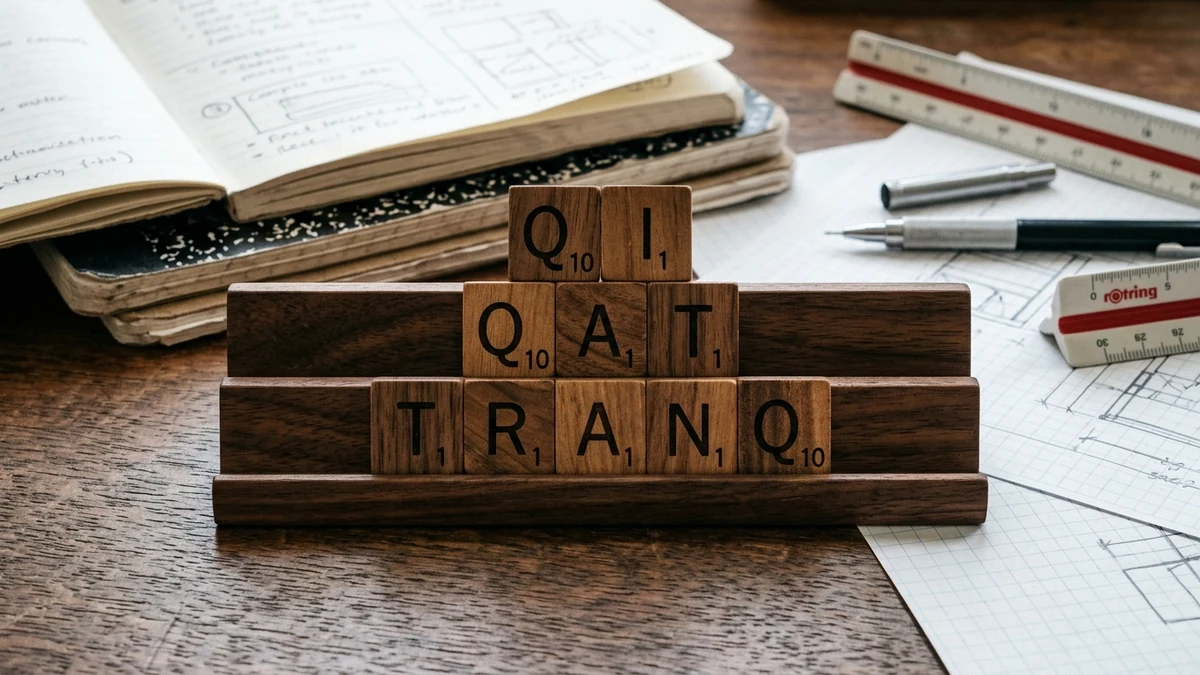
Words With Q Without U: Complete Tournament List
Words with Q without U are specialized, tournament-legal words derived primarily from Arabic, Chinese, and Hebrew transliterations that permit playing the 10-point Q tile without a U. Essential valid plays include QI (11 pts), QAT (12 pts), FAQIR (17 pts), TRANQ (14 pts), and QIN (12 pts).
| Valid Word | Scrabble Pts | WWF Pts | Part of Speech | Official Definition & Tactical Usage |
|---|---|---|---|---|
| QI | 11 pts | 11 pts | noun | Vital life force in traditional Chinese medicine; primary 2-letter hook. |
| QAT | 12 pts | 12 pts | noun | An evergreen shrub native to East Africa and Arabia; chewed as a stimulant. |
| QIS | 12 pts | 12 pts | noun pl. | Plural of QI; valid tournament pluralization. |
| QIN | 12 pts | 13 pts | noun | A Chinese seven-stringed zither of the ancient period. |
| QADI | 14 pts | 15 pts | noun | A Muslim judge who interprets and administers Islamic law. |
| QAID | 14 pts | 15 pts | noun | A Muslim chieftain or magistrate; governor of a district. |
| QATS | 13 pts | 13 pts | noun pl. | Plural of QAT; premier 4-letter defense word. |
| QINS | 13 pts | 14 pts | noun pl. | Plural of QIN; valid tournament plural. |
| QOPH | 18 pts | 17 pts | noun | The 19th letter of the Hebrew alphabet (variant of KOPH). |
| WAQF | 19 pts | 19 pts | noun | An Islamic endowment of property for charitable purposes. |
| CINQ | 15 pts | 16 pts | noun | The number five in dice, cards, or dominoes (Collins CSW). |
| CINQS | 16 pts | 17 pts | noun pl. | Plural of CINQ; high-value defensive placement. |
| FAQIR | 17 pts | 17 pts | noun | A Muslim religious ascetic or dervish who lives by alms. |
| NIQAB | 16 pts | 17 pts | noun | A veil covering the face, worn by some Muslim women. |
| QADIS | 15 pts | 16 pts | noun pl. | Plural of QADI; key high-probability play. |
| QAIDS | 15 pts | 16 pts | noun pl. | Plural of QAID; vital 5-letter hook. |
| QANAT | 14 pts | 15 pts | noun | An gently sloping underground irrigation channel. |
| QIBLA | 16 pts | 17 pts | noun | The direction toward Mecca, faced by Muslims during prayer. |
| QOPHS | 19 pts | 18 pts | noun pl. | Plural of QOPH; high-scoring 5-letter placement. |
| QORMA | 16 pts | 17 pts | noun | A mildly spiced curry dish made with yogurt or cream (variant of KORMA). |
| TALAQ | 14 pts | 15 pts | noun | Divorce in Islamic law, effected by the husband pronouncing talaq. |
| TRANQ | 14 pts | 16 pts | noun | Slang abbreviation for a tranquilizer medication. |
| WAQFS | 20 pts | 20 pts | noun pl. | Plural of WAQF; exceptional 20-point natural score. |
| BURQA | 16 pts | 17 pts | noun | Loose protective garment with veiled eyeholes (CSW standard). |
| FAQIRS | 18 pts | 18 pts | noun pl. | Plural of FAQIR; standard tournament play. |
| NIQABS | 17 pts | 18 pts | noun pl. | Plural of NIQAB; legal tournament play. |
| QABALA | 17 pts | 18 pts | noun | Ancient Jewish mystical tradition (variant of KABBALAH). |
| QANATS | 15 pts | 16 pts | noun pl. | Plural of QANAT; high-frequency vowel balance. |
| QASIDA | 16 pts | 17 pts | noun | An ancient Arabic poetic form with a single rhyme. |
| QAWWAL | 21 pts | 21 pts | noun | A singer of Sufi devotional music (qawwali). |
| QIBLAS | 17 pts | 18 pts | noun pl. | Plural of QIBLA; tournament legal. |
| QIGONG | 17 pts | 19 pts | noun | A Chinese system of physical exercises and breathing control. |
| QINDAR | 16 pts | 18 pts | noun | Monetary unit of Albania, equal to one-hundredth of a lek. |
| QINTAR | 16 pts | 17 pts | noun | Variant spelling of QINDAR in official dictionaries. |
| QORMAS | 17 pts | 18 pts | noun pl. | Plural of QORMA; culinary loanword. |
| QWERTY | 21 pts | 22 pts | noun/adj | Denoting the standard English typewriter and computer keyboard. |
| SHEQEL | 18 pts | 18 pts | noun | Basic monetary unit of Israel (variant of SHEKEL). |
| TALAQS | 15 pts | 16 pts | noun pl. | Plural of TALAQ; essential 6-letter play. |
| TRANQS | 15 pts | 17 pts | noun pl. | Plural of TRANQ; valuable defensive play. |
| INQILAB | 18 pts | 20 pts | noun | Revolution or political uprising in Urdu and Hindi. |
| QABALAH | 21 pts | 22 pts | noun | Variant spelling of QABALA; high-scoring play. |
| QAWWALI | 22 pts | 22 pts | noun | A style of Muslim devotional music associated with Sufism. |
| QINDARS | 17 pts | 19 pts | noun pl. | Plural of QINDAR; valuable 7-letter bingo play. |
| QINTARS | 17 pts | 18 pts | noun pl. | Plural of QINTAR; official tournament bingo. |
| TSADDIQ | 19 pts | 21 pts | noun | A righteous person in Jewish tradition (variant of TZADDIQ). |
| MBAQANGA | 22 pts | 27 pts | noun | A rhythmic style of South African township jazz music. |
| SHEQALIM | 22 pts | 24 pts | noun pl. | Plural of SHEQEL; premier 8-letter bonus play. |
| TSADDIQIM | 23 pts | 25 pts | noun pl. | Plural of TSADDIQ; tournament legal 9-letter play. |
Length Breakdown: 2-Letter to 8-Letter Tournament Plays
The 10-point Q tile is historically the most dangerous letter to hold on a Scrabble or Words With Friends rack. Without a U tile, uneducated players often surrender a turn to swap letters. Memorizing these essential tournament loanwords transforms the Q from a liability into a game-winning asset:
2-Letter & 3-Letter Critical Plays
QI (11 pts): The single most vital play in competitive Scrabble. Originating from Chinese philosophy, QI hooks with S into QIS (12 pts).
QAT (12 pts): An Arabian shrub chewed as a stimulant. Hooks cleanly with S into QATS (13 pts).
4-Letter Tactical Hooks
QAID (14 pts): A Middle Eastern chieftain or judge. Pluralizes as QAIDS (15 pts).
TRANQ (14 pts): Colloquial abbreviation for tranquilizer. Pluralizes as TRANQS (15 pts).
Strategic Defense: Playing Q Without U on Bonus Squares
The ultimate tactical execution with a Q tile is landing QI across a Triple Letter (TL) score while simultaneously forming an intersecting transverse word. Playing QI horizontally on a TL square awards 31 points (Q=30, I=1). If the Q concurrently completes a downward word, the move score doubles to over 60 points on a single turn. Conversely, defensive awareness requires never leaving an open 'I' adjacent to an unoccupied Triple Letter or Triple Word score. Similar to unassisted Q tiles, holding an X requires immediate tactical dumping; browse the tactical X-tile word list sorted by length.
Linguistic Origins of English Q-Without-U Words
The historical pairing of Q with U in English spelling stems from Norman French and Latin orthographic conventions. In classical Latin, the letter Q represented a labiovelar stop [kʷ], which required an audible rounding of the lips recorded as the vowel U. However, modern tournament English lexicons incorporate loanwords from Semitic languages (Arabic and Hebrew), Chinese Pinyin, and Indigenous American tongues where the letter Q represents an independent voiceless uvular stop [q] articulated at the back of the vocal tract.
Because these languages treat the uvular stop as an autonomous consonant rather than a labialized glide, standard linguistic transliteration into the Latin alphabet uses Q without an appended U. Recognizing this distinction empowers competitive players to spot words like SUQ (a Middle Eastern marketplace), CINQ (the number five in dice games), and QIGONG (a traditional Chinese system of coordinated physical postures and breath control) without hesitating or second-guessing tournament legality.
The Negative Leave Penalty of the Q Tile (-8.4 Points)
Statistical analysis conducted by the North American SCRABBLE Players Association demonstrates that the letter Q has the most severe negative rack leave value of any tile in the game, averaging -8.4 points per turn. The primary mistake casual players make is "fishing for a U"—holding onto the Q across multiple turns in the vain hope of drawing one of the bag's four U tiles.
With only four U tiles in a 100-tile set (a mere 4.0% frequency), the mathematical probability of drawing a U on any single turn is less than 18%. Clinging to the Q while waiting for a U stalls your rack, forces defensive filler plays, and forfeits tempo. In contrast, expert players treat the Q as an urgent emergency tile: if a U is not already on the rack, they dump the Q on the very first turn using loanwords like QI, QAT, or SUQ to clear the rack, recover elasticity, and reset their scoring momentum.
Defensive Geometry: Starving the Opponent of 'I' Tiles
Because QI is the most versatile 2-letter word in tournament play (requiring only a single vowel hook), elite defensive play demands strict vigilance over all open 'I' tiles on the board. Leaving an 'I' tile exposed adjacent to an unoccupied Double Letter, Triple Letter, or Triple Word score square is known in competitive circles as "serving the Q on a silver platter."
If an opponent holds the unplayed Q and spots an open I on a Triple Letter square, they can play QI for 31 points horizontally while simultaneously connecting into a downward play, easily generating a 60-to-75 point turn. Defensive board management dictates that when the Q has not yet been played from the bag, you must avoid creating open hook lanes with exposed I's, or immediately block existing ones with low-point defensive plays.
Medium & Long Q-Without-U Tournament Words (5 to 8 Letters)
Beyond the immediate short plays of QI and QAT, expanding your vocabulary into 5-letter and longer Q-without-U words enables decisive 50-point bonus plays. Words such as QANAT (an ancient Middle Eastern irrigation system), QIBLA (the sacred orientation toward the Kaaba), QOPHS (the nineteenth letter of the Semitic alphabet), and SHEQEL (the ancient and modern Israeli unit of currency) clear difficult consonant-heavy racks while netting formidable points.
For international tournament play under Collins CSW21 standards, master players also memorize extended entries such as QABALA (mystical tradition), QIGONG (breath cultivation exercise), TRANQ (tranquilizer), and the legendary 8-letter bingo MBAQANGA (a Zulu-influenced style of South African jazz). Landing MBAQANGA across a Triple Word score represents one of the highest possible single-turn scores in competitive board gaming history.
Frequently Asked Questions About Q Without U Words
Essential tournament clarifications for competitive Scrabble and Words With Friends.
Is QI legally acceptable in Scrabble and Words With Friends?
Yes. QI is officially accepted in both NASPA (NWL20) and Collins (CSW21) Scrabble tournament rules, as well as Words With Friends. It is worth 11 points (Q=10, I=1).
How many valid words with Q and no U exist in English word games?
There are approximately 44 tournament-legal words containing a Q without a U in the Collins (CSW21) lexicon and 33 in the North American (NWL20) lexicon, ranging from 2-letter QI to 8-letter MBAQANGA.
What is the highest-scoring Q-without-U word?
MBAQANGA scores 22 base points in Scrabble and 27 base points in Words With Friends. When played as a 7-tile or 8-tile bingo across bonus squares, move totals frequently exceed 120 points.
Why do so many Q-without-U words originate from Arabic or Hebrew?
In Arabic, Hebrew, and Persian transliterations into the Latin alphabet, the uvular stop consonant is transliterated as 'q' without requiring the subsequent labial glide 'u' that European languages mandate.